


a day IN Provence:
between landscapes, hilltop villages and the art of living


In the collective imagination, Provence is a land of endless lavender fields, of hilltop villages clinging to the slopes, of lively markets painted in every hue, and of fragrances drifting in the air—thyme, rosemary, and freshly gathered olives.
Yet Provence is far more than these images alone.
To wander through Provence is to step into a fertile, generous land, brimming with stories and landscapes where limestone stones meet an infinite blue sky, where plains rise into mountains, and where the art of living intertwines with age-old traditions.
I invite you to follow me on my journeys, where I am forever in awe—at times before a centuries-old building, at times at an old tale that gives meaning to the present, or at the discovery of a timeless craft that still endures today…


A day in Aix-en-Provence


"Aix-en-Provence—once Aquae Sextiae—was born of its steaming waters in 122 BC, when the Roman consul Calvinus Sextius sought a place of rest for his legions marching in the glory of Rome. The first spa town of its kind, blessed by its hot springs, it would later become the seat of the Counts of Provence in the Middle Ages, before yielding to France in 1481 upon the death of the beloved Good King René.
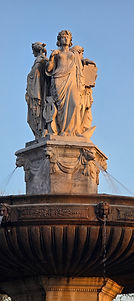
Today, this city—fondly called “the City of a Thousand Fountains”—is a haven of gentle living: with its bustling markets thrice each week, its fountains murmuring in avenues and squares, its oratories whispering of fervent faith, and its grand townhouses recalling the prestige of a Renaissance past.
I invite you to wander through Aix-en-Provence with me: through the stories hidden in the names of its streets, through its intimate bond with water, through its illustrious men and women, its darker hours of history, and its rich, time-honored gastronomy…"



A day in Luberon

"I fell in love with the Luberon last summer, from the very first steps of my guided tours. Until then, I had only brushed against this natural sanctuary—long ago, when I wandered through Lourmarin with my children, back when they still dreamed of knights and princesses.
The Luberon—its name born from the Latin luvio, the she-wolf—is a refuge, a realm beyond time. It draws us back into the Middle Ages, enchants us with its vineyards and silver-green olive groves, and teaches us resilience and the quiet courage of humankind across the centuries.
I invite you to uncover this extraordinary land: through the turbulent tales of the Wars of Religion in the 16th century, through its role in the Resistance during the Second World War, through its hilltop villages and its generous, fertile soil—where hidden treasures lie, waiting to be revealed."


A day in Eguilles

"An Éguilienne by adoption for the past fifteen years, I longed to delve deeper into the soul of this village that has become my home. During my internship to complete my training as a guide, I asked the mayor of this town of 8,000 souls if I might weave a path—a journey of discovery—for locals and travelers alike. My wish was granted, and I was far from disappointed! For what fascinating tales lie hidden behind these walls, these familiar streets we tread without suspecting their secret wealth. Tales of territorial strife, of religious wars, of celebrated artists; of a château reborn time and again, wearing many faces, serving many destinies.
And so, I invite you to wander with me through this hilltop village, poised at the gates of Aix-en-Provence. Discover its millennial story rooted in vineyards and olive groves, its lavoirs and fountains whispering of daily life, its illustrious inhabitants whose presence still lingers in the stones."


A day in Verdon
"As I journey deeper into the heart of Provence, I begin to perceive the invisible threads that weave its every element into one inseparable whole… I cannot help but link the Verdon—an Alpine river carving its path toward Provence—to the city of Aix-en-Provence, long nourished by its benevolent waters, so vital to the city’s growth. Did you know that the abundant waters of the Verdon first surged into the Fontaine de la Rotonde on August 16, 1875, thanks to the grand works decreed by Prince-President Napoleon III, after years of pleas from a town once reliant only upon its underground springs?
When we wander through the gorges of the Verdon, we will speak not only of humankind’s presence here for more than 40,000 years, but we will also discover the village of Moustiers-Sainte-Marie, rising in majesty against the cliff—a natural fortress for the monks who founded it in the 5th century. Through centuries of legends and trials, it has endured to become today the famed village of faience, its ceramics gracing even the walls of Louis XIV’s palace at Versailles.
And then, should courage carry us higher still, we will climb the cliffs of the Verdon, known across the world for their vertiginous climbs. From above, we will behold the plain transformed in the 1970s into the turquoise waters of Lake Sainte-Croix—waters said to shimmer with the magic of a legend: when a river nymph shattered a precious stone once gifted to her by a knight hopelessly in love, the dark and tumbling currents were transfigured into an emerald oasis, radiant and serene."


A day in the Alpilles
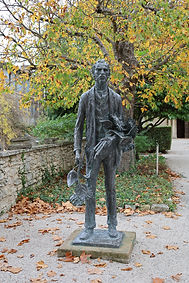
The Alpilles, “Aupiho” — the “little Alps” — form a modest mountain range nestled between Aix-en-Provence and the Camargue. They rise like a miniature Sainte-Victoire, draped in limestone and sculpted with soft, rounded curves. This marvel of nature, born in the Late Jurassic, took shape during the mighty upheaval that gave birth to the Pyrenees and the Alps. Since time immemorial, it has sheltered humankind — from the prehistoric dwellers of the Oppidum des Caisses de Jean-Jean near Mouriès, to the Romans of the ancient city of Glanum.
Yet what draws us irresistibly to the Alpilles is the memory of a man who, on a February day in 1888, arrived in Arles with the simple ambition of reaching Marseille. Fate, however, had other plans: he would remain there for two years, in a feverish quest for color, light, and form — a quest to perfect the delicate art inspired by Japanese prints.
That man was Vincent van Gogh — an unknown and solitary soul, mercurial and misunderstood, who in his lifetime never sold a single painting. And yet, if only he could see it now, he draws thousands of pilgrims who, perhaps like myself, come in search of that same light that once ignited his passion — and to fathom what despair seized him on that December night in 1888, when he took a blade to his own ear.
From that act of madness sprang canvases born of violence and grace — painted in urgent, swirling strokes that built up thick, trembling layers of color. To gaze upon a Van Gogh is to feel the mistral whispering through the olive groves, rippling across the wheat fields, to be swept away by the celestial whirlpools of The Starry Night.
Yes, I love Van Gogh. And I love to walk in his footsteps — imagining him wandering through every hidden fold of the Alpilles, seeking a serenity that, I like to believe, he found — if only for a fleeting moment.


About Me
Passionate about history and travel
My name is Corinne, a bilingual guide and storyteller, driven by the art of capturing fleeting moments through the lens of my camera.
This blog is a window flung wide open onto my journeys across Provence—the land I wander each day, in search of beauty and meaning.
Come with me to explore its picture-postcard landscapes, to uncover ancestral crafts still alive in the hands of artisans, and to share curious tales from a region that has endured through the ages—ever since its Roman annexation more than two thousand years ago.


Any question? Any comment? Any thought? Join me at cocoinprovence@gmail.com or fill in the following contact form!

1170 chemin de Valsère
13510 Eguilles, France

